
Performance and Bigger Data: Vectorisation, Memory, Parquet, Polars and DuckDB
Make Python data work fast and scale beyond memory. Measure with timeit, replace loops with vectorised code, shrink DataFrames with the right dtypes, store data as Parquet, use Polars lazy queries and DuckDB for out-of-core analytics, and know when to move to Spark and the cloud.
- Measure speed and memory before optimising
- Replace row loops and apply with vectorised pandas and NumPy operations
- Reduce memory with categories, smaller numeric types and selected columns
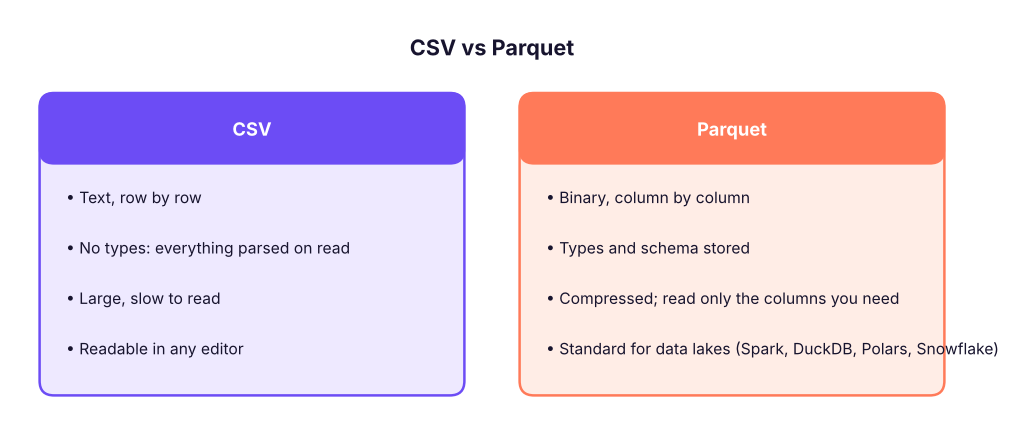
- Store and read data efficiently with Parquet and explain columnar formats
- Write equivalent queries in pandas, Polars and DuckDB and choose between them
Measure first
"Premature optimisation is the root of all evil" (Donald Knuth). Profile, find the slow part, fix that.
import pandas as pd, numpy as np, time, timeit
s = pd.read_csv("superstore_sales.csv", parse_dates=["order_date"])
big = pd.concat([s] * 20, ignore_index=True)                  # ~126k rows to make timings visible
print(big.shape)
def t(fn, n=3): return min(timeit.repeat(fn, number=1, repeat=n)) * 1000
loop = lambda: [r.sales * (1 - r.discount) for r in big.itertuples()]
apply_ = lambda: big.apply(lambda r: r["sales"] * (1 - r["discount"]), axis=1)
vec = lambda: big["sales"] * (1 - big["discount"])
print(f"itertuples loop {t(loop, 1):8.1f} ms\napply(axis=1) {t(apply_, 1):8.1f} ms\nvectorised {t(vec):8.2f} ms")(126460, 19) itertuples loop 1070.5 ms apply(axis=1) 659.5 ms vectorised 0.65 ms
The vectorised version is more than a thousand times faster. itertuples and apply(axis=1) take about the same time because both are Python loops (apply with axis=1 is a loop in disguise), and iterrows is slower still.
Vectorising conditional logic
def band_loop(d): return "high" if d > 0.2 else "mid" if d > 0 else "none"
f1 = lambda: big["discount"].map(band_loop)
f2 = lambda: np.select([big.discount > 0.2, big.discount > 0], ["high", "mid"], default="none")
f3 = lambda: pd.cut(big.discount, [-1, 0, 0.2, 1], labels=["none", "mid", "high"])
print(f"map(func) {t(f1):.1f} ms | np.select {t(f2):.1f} ms | pd.cut {t(f3):.1f} ms")
print((f1().values == f2()).all())map(func) 15.6 ms | np.select 1.0 ms | pd.cut 1.5 ms True
| Slow pattern | Faster pattern |
|---|---|
for/iterrows over rows |
Column arithmetic, np.where, np.select |
apply(axis=1) |
Vectorised expression, or groupby().transform |
Growing a DataFrame in a loop (concat each time) |
Collect a list of dicts, build once |
| String ops in Python loops | .str methods |
Repeated df[df.x == k] in a loop |
One groupby |
| Reading a big CSV many times | Read once, save as Parquet |
Memory
def mb(df): return df.memory_usage(deep=True).sum() / 1e6
print(f"original: {mb(big):.1f} MB")
small = big.copy()
for c in ["region", "segment", "category", "sub_category", "ship_mode", "state", "city"]: small[c] = small[c].astype("category")
small["quantity"] = pd.to_numeric(small["quantity"], downcast="integer")
small[["sales", "profit", "discount"]] = small[["sales", "profit", "discount"]].astype("float32")
print(f"categories + downcast: {mb(small):.1f} MB")
print(small.dtypes.astype(str).value_counts().to_dict())original: 34.7 MB
categories + downcast: 18.3 MB
{'category': 7, 'str': 6, 'float32': 3, 'int64': 1, 'datetime64[us]': 1, 'int8': 1}Categories store each label once plus small integer codes: ideal for columns with few distinct values. Also read only needed columns (usecols=) and stream with chunksize=.
total = 0.0
for chunk in pd.read_csv("superstore_sales.csv", usecols=["region", "sales"], chunksize=2000):
    total += chunk.loc[chunk.region == "West", "sales"].sum()
print(f"West sales via chunks: {total:,.0f}")West sales via chunks: 51,958,520
Parquet: the analytics file format
import os
big.to_csv("big.csv", index=False); big.to_parquet("big.parquet", index=False)
print(f"CSV {os.path.getsize('big.csv')/1e6:.1f} MB | Parquet {os.path.getsize('big.parquet')/1e6:.1f} MB")
print(f"read CSV {t(lambda: pd.read_csv('big.csv')):.0f} ms | read Parquet {t(lambda: pd.read_parquet('big.parquet')):.0f} ms | two columns {t(lambda: pd.read_parquet('big.parquet', columns=['region', 'sales'])):.0f} ms")CSV 21.7 MB | Parquet 1.9 MB read CSV 249 ms | read Parquet 15 ms | two columns 5 ms
Polars: fast DataFrames with lazy queries
Polars is a DataFrame library written in Rust. It uses all CPU cores, the Arrow memory format, and a lazy mode that optimises the whole query before running it.
import polars as pl
lazy = (pl.scan_parquet("big.parquet")                         # nothing is read yet
          .filter(pl.col("discount") <= 0.1)
          .group_by("region", "category")
          .agg(sales=pl.col("sales").sum(), profit=pl.col("profit").sum(), lines=pl.len())
          .with_columns(margin=(100 * pl.col("profit") / pl.col("sales")).round(1), sales_m=(pl.col("sales") / 1e6).round(2))
          .drop("profit")
          .sort("sales", descending=True))
print(lazy.head(4).collect().drop("sales"))
pandas_way = lambda: (big[big.discount <= 0.1].groupby(["region", "category"]).agg(sales=("sales", "sum"), profit=("profit", "sum")))
print(f"pandas {t(pandas_way):.1f} ms | polars lazy {t(lambda: lazy.collect()):.1f} ms | polars {pl.__version__}")shape: (4, 5) ┌────────┬────────────┬───────┬────────┬─────────┐ │ region ┆ category ┆ lines ┆ margin ┆ sales_m │ │ --- ┆ --- ┆ --- ┆ --- ┆ --- │ │ str ┆ str ┆ u32 ┆ f64 ┆ f64 │ ╞════════╪════════════╪═══════╪════════╪═════════╡ │ South ┆ Technology ┆ 7220 ┆ 15.9 ┆ 642.79 │ │ West ┆ Technology ┆ 7080 ┆ 16.1 ┆ 604.14 │ │ North ┆ Technology ┆ 6720 ┆ 16.6 ┆ 598.63 │ │ East ┆ Technology ┆ 6320 ┆ 17.5 ┆ 531.33 │ └────────┴────────────┴───────┴────────┴─────────┘ pandas 22.0 ms | polars lazy 3.9 ms | polars 2.1.0
| pandas | Polars |
|---|---|
df[df.x > 1] |
df.filter(pl.col("x") > 1) |
df.assign(y=df.x * 2) |
df.with_columns(y=pl.col("x") * 2) |
df.groupby("g").agg(s=("x", "sum")) |
df.group_by("g").agg(s=pl.col("x").sum()) |
df.sort_values("x") |
df.sort("x") |
pd.read_csv |
pl.read_csv / lazy pl.scan_csv |
df.to_pandas() ↔ pl.from_pandas(df) |
Convert when a library needs pandas |
DuckDB on files larger than memory
import duckdb
q = """
SELECT region, category, ROUND(SUM(sales)/1e6, 2) AS sales_m, ROUND(100*SUM(profit)/SUM(sales), 1) AS margin
FROM 'big.parquet' WHERE discount <= 0.1 GROUP BY ALL ORDER BY sales_m DESC LIMIT 4
"""
print(duckdb.sql(q).df())
print(f"duckdb {t(lambda: duckdb.sql(q).fetchall()):.1f} ms")
for f in ("big.csv", "big.parquet"): os.remove(f)region category sales_m margin 0 South Technology 642.79 15.9 1 West Technology 604.14 16.1 2 North Technology 598.63 16.6 3 East Technology 531.33 17.5 duckdb 7.0 ms
DuckDB and Polars stream data in batches, so they can process files bigger than RAM on a laptop. Folders of Parquet files ('data/*.parquet') work the same way.
Going further
| Need | Tool |
|---|---|
| Use all CPU cores for custom Python | concurrent.futures, joblib.Parallel, multiprocessing |
| Speed up numeric Python loops | Numba (@njit), Cython |
| Data bigger than one machine | Apache Spark (PySpark), Databricks, Dask, Ray |
| Warehouse-scale SQL | BigQuery, Snowflake, Redshift, Databricks SQL |
| GPU DataFrames | RAPIDS cuDF (cudf.pandas) |
Rule of thumb: up to a few GB → pandas with good dtypes; up to ~100 GB on one machine → Polars or DuckDB with Parquet; beyond that or many users → Spark or a cloud warehouse.
Summary
- Measure with
timeit/%timeitbefore optimising; fix the bottleneck. - Vectorise: column arithmetic,
np.where/np.select,pd.cut,.str,groupby; avoiditerrowsandapply(axis=1). - Save memory with categories, downcasting,
usecolsandchunksize. - Parquet is columnar, typed and compressed: faster and smaller than CSV.
- Polars (lazy, multi-core) and DuckDB (SQL, out-of-core) handle data beyond pandas; Spark and warehouses go beyond one machine.
1. Which is usually fastest for row-wise arithmetic?
2. Why convert a text column with 4 distinct values to category?
3. What is the main advantage of Parquet over CSV?
4. What does Polars' scan_parquet(...) do?
5. Which tool queries Parquet files with SQL without a server?
6. When should you consider Spark or a cloud warehouse?
(1) Time iterrows, apply(axis=1) and a vectorised version of profit / sales on big. (2) Reduce the memory of superstore_sales.csv by at least 50% and report the percentage. (3) Rewrite a pandas groupby from Lesson 18 in Polars and in DuckDB SQL and check that the numbers match.
Show solution
print(t(lambda: [r["profit"] / r["sales"] for _, r in big.head(20000).iterrows()], 1))
print(t(lambda: big.profit / big.sales))
before = mb(s); s2 = s.copy()
for c in s2.select_dtypes("object").columns.union(s2.select_dtypes("string").columns):
    if s2[c].nunique() < 100: s2[c] = s2[c].astype("category")
print(f"{100 * (1 - mb(s2) / before):.0f}% smaller")
pl_res = pl.from_pandas(s).group_by("region").agg(pl.col("sales").sum()).sort("region")
dd_res = duckdb.sql("SELECT region, SUM(sales) sales FROM s GROUP BY region ORDER BY region").df()Q: Your pandas script is slow. What do you do?
Profile to find the slow step; vectorise loops and apply; reduce data early (filter, usecols); fix dtypes; avoid repeated work; save intermediate results as Parquet; consider Polars/DuckDB or pushing work to SQL.
Q: Why is Parquet popular in data lakes? Columnar storage enables compression and reading only needed columns; it stores the schema; and every major engine reads it.
Q: pandas vs Polars? pandas has the biggest ecosystem; Polars is faster and more memory-efficient thanks to Rust, multi-threading and lazy optimisation. Many teams use both and convert where needed.
Practise more online
Free, trusted places to test yourself on this topic. Links open the original site in a new tab.