
DSA I: Big-O, Arrays, Strings, Hashing, Two Pointers and Sliding Window
Data structures and algorithms for data-analyst, data-scientist and data-engineer interviews. Learn Big-O time and space complexity, then the patterns that solve most array and string questions (hash maps and sets, prefix sums, two pointers, sliding window), with worked interview problems and timings.
- Estimate time and space complexity with Big-O and compare common growth rates
- Know the cost of operations on lists, dicts, sets and deques
- Solve array and string problems with hash maps, counting and prefix sums
- Apply the two-pointer and sliding-window patterns
- Explain trade-offs out loud as in a coding interview
Why DSA for data roles?
Data interviews (Amazon, Flipkart, Walmart, fintechs, product companies) often include one or two coding rounds with easy–medium problems on arrays, strings, hash maps and SQL. Beyond interviews, complexity thinking explains why a join on a set is instant while a nested loop over two million rows never finishes.
Big-O notation
Big-O describes how running time (or memory) grows with input size n, ignoring constants.
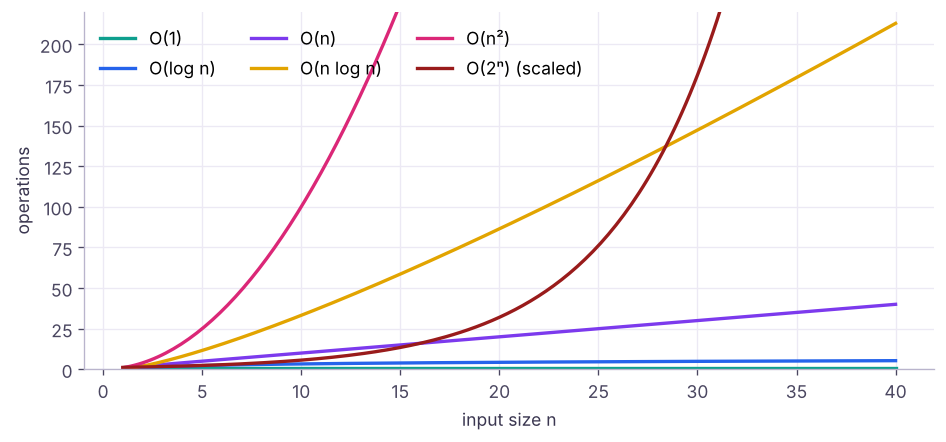
| Big-O | Name | Example |
|---|---|---|
| O(1) | Constant | Dict lookup, list index, append |
| O(log n) | Logarithmic | Binary search, balanced-tree lookup |
| O(n) | Linear | One loop, x in list, sum |
| O(n log n) | Linearithmic | Sorting (sorted, Timsort), merge sort |
| O(n²) | Quadratic | Nested loops over the same data |
| O(2ⁿ) | Exponential | All subsets, naive recursion for Fibonacci |
Rules: drop constants (O(2n) → O(n)); keep the dominant term (O(n² + n) → O(n²)); sequential steps add, nested steps multiply.
import time
def has_duplicate_quadratic(a):
    for i in range(len(a)):
        for j in range(i + 1, len(a)):
            if a[i] == a[j]: return True
    return False
def has_duplicate_set(a): return len(set(a)) != len(a)
for n in (1000, 2000, 4000):
    data = list(range(n))
    t0 = time.perf_counter(); has_duplicate_quadratic(data); t1 = time.perf_counter(); has_duplicate_set(data); t2 = time.perf_counter()
print(f"n={n:5d}: nested loops {1000*(t1-t0):7.1f} ms | set {1000*(t2-t1):.3f} ms")n= 1000: nested loops 15.1 ms | set 0.022 ms n= 2000: nested loops 59.7 ms | set 0.042 ms n= 4000: nested loops 261.3 ms | set 0.088 ms
Doubling n roughly quadruples the nested-loop time (O(n²)) but only doubles the set version (O(n)).
Cost of Python operations
| Operation | list | dict / set | deque |
|---|---|---|---|
Index a[i] |
O(1) | — | O(n) |
| Append / pop at end | O(1) | add O(1) | O(1) |
| Insert / pop at front | O(n) | — | O(1) |
x in c |
O(n) | O(1) | O(n) |
| Sort | O(n log n) | — | — |
Pattern 1: hash maps and counting
Turn "search inside a loop" (O(n²)) into "look up in a dict/set" (O(n)).
def two_sum(nums, target):
    """Return indices of two numbers adding up to target. O(n) time, O(n) space."""
    seen = {}                                  # value -> index
    for i, x in enumerate(nums):
        if target - x in seen: return [seen[target - x], i]
        seen[x] = i
    return []
print(two_sum([2, 7, 11, 15], 9), two_sum([3, 2, 4], 6), two_sum([1, 2], 7))

from collections import Counter, defaultdict
def is_anagram(a, b): return Counter(a) == Counter(b)
def group_anagrams(words):
    g = defaultdict(list)
    for w in words: g["".join(sorted(w))].append(w)
    return list(g.values())
def first_unique_char(s):
    c = Counter(s)
    return next((i for i, ch in enumerate(s) if c[ch] == 1), -1)
def top_k_frequent(nums, k): return [x for x, _ in Counter(nums).most_common(k)]
print(is_anagram("listen", "silent"), group_anagrams(["eat", "tea", "tan", "ate", "nat", "bat"]), first_unique_char("leetcode"), top_k_frequent([1, 1, 1, 2, 2, 3], 2))[0, 1] [1, 2] [] True [['eat', 'tea', 'ate'], ['tan', 'nat'], ['bat']] 0 [1, 2]
Pattern 2: prefix sums
Precompute running totals so any range sum is O(1).
from itertools import accumulate
sales = [5, 3, 8, 6, 2, 7]
prefix = [0] + list(accumulate(sales))                # prefix[i] = sum of first i items
range_sum = lambda i, j: prefix[j + 1] - prefix[i]    # sum of sales[i..j]
print(prefix, range_sum(1, 3), range_sum(0, 5))

def subarray_sum_equals_k(nums, k):
    """Count contiguous subarrays summing to k. O(n) with prefix sums + a counter."""
    count, running, seen = 0, 0, Counter({0: 1})
    for x in nums:
        running += x
        count += seen[running - k]
        seen[running] += 1
    return count
print(subarray_sum_equals_k([1, 1, 1], 2), subarray_sum_equals_k([1, 2, 3, -3, 3], 3))[0, 5, 8, 16, 22, 24, 31] 17 31 2 5
Pattern 3: two pointers
Two indices move toward each other (or in the same direction) through a sorted array or string.
def is_palindrome(s):
    s = [c.lower() for c in s if c.isalnum()]
    i, j = 0, len(s) - 1
    while i < j:
        if s[i] != s[j]: return False
        i += 1; j -= 1
    return True
def pair_with_sum_sorted(a, target):
    i, j = 0, len(a) - 1
    while i < j:
        total = a[i] + a[j]
        if total == target: return a[i], a[j]
        if total < target: i += 1
        else: j -= 1
    return None
def remove_duplicates_sorted(a):              # in place, returns new length
    if not a: return 0
    w = 1
    for r in range(1, len(a)):
        if a[r] != a[w - 1]: a[w] = a[r]; w += 1
    return w
def merge_sorted(a, b):
    i = j = 0; out = []
    while i < len(a) and j < len(b):
        if a[i] <= b[j]: out.append(a[i]); i += 1
        else: out.append(b[j]); j += 1
    return out + a[i:] + b[j:]
arr = [1, 1, 2, 3, 3, 3, 4]; n = remove_duplicates_sorted(arr)
print(is_palindrome("A man, a plan, a canal: Panama"), pair_with_sum_sorted([1, 3, 4, 6, 9], 10), arr[:n], merge_sorted([1, 4, 9], [2, 3, 10]))True (1, 9) [1, 2, 3, 4] [1, 2, 3, 4, 9, 10]
Pattern 4: sliding window
Keep a window [left, right] and slide it, updating a running state instead of recomputing.
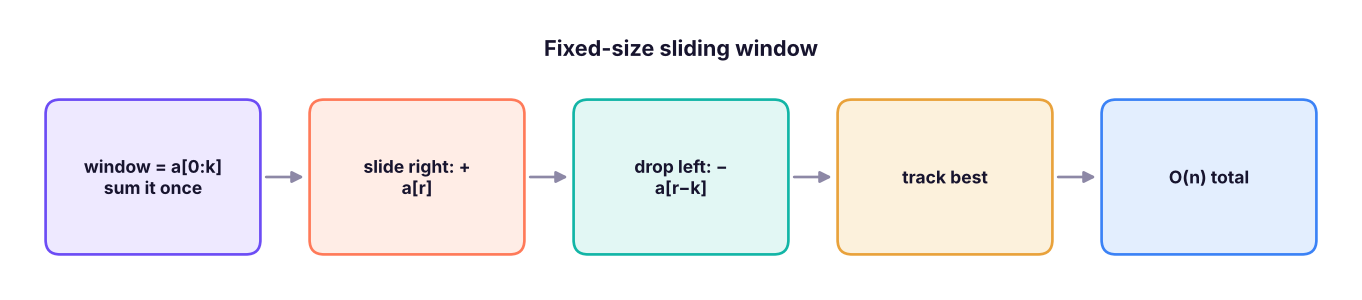
def max_sum_window(a, k):
    window = best = sum(a[:k])
    for r in range(k, len(a)):
        window += a[r] - a[r - k]
        best = max(best, window)
    return best
def longest_unique_substring(s):
    last, left, best = {}, 0, 0
    for right, ch in enumerate(s):
        if ch in last and last[ch] >= left: left = last[ch] + 1     # shrink past the repeat
        last[ch] = right; best = max(best, right - left + 1)
    return best
def min_window_at_least(nums, target):          # shortest subarray with sum >= target (positive numbers)
    left = total = 0; best = float("inf")
    for right, x in enumerate(nums):
        total += x
        while total >= target:
            best = min(best, right - left + 1); total -= nums[left]; left += 1
    return 0 if best == float("inf") else best
print(max_sum_window([2, 1, 5, 1, 3, 2], 3), longest_unique_substring("abcabcbb"), longest_unique_substring("pwwkew"), min_window_at_least([2, 3, 1, 2, 4, 3], 7))9 3 3 2
The same idea appears in SQL window functions and in pandas rolling: a 7-day moving average is a sliding window.
Classic array problems
def max_profit(prices):                          # best single buy then sell
    lo, best = float("inf"), 0
    for p in prices: lo = min(lo, p); best = max(best, p - lo)
    return best
def max_subarray(nums):                          # Kadane's algorithm
    cur = best = nums[0]
    for x in nums[1:]: cur = max(x, cur + x); best = max(best, cur)
    return best
def product_except_self(nums):
    n = len(nums); out = [1] * n; left = right = 1
    for i in range(n): out[i] = left; left *= nums[i]
    for i in range(n - 1, -1, -1): out[i] *= right; right *= nums[i]
    return out
def move_zeroes(a):
    w = 0
    for x in a:
        if x != 0: a[w] = x; w += 1
    a[w:] = [0] * (len(a) - w); return a
def rotate(a, k): k %= len(a); return a[-k:] + a[:-k]
print(max_profit([7, 1, 5, 3, 6, 4]), max_subarray([-2, 1, -3, 4, -1, 2, 1, -5, 4]), product_except_self([1, 2, 3, 4]), move_zeroes([0, 1, 0, 3, 12]), rotate([1, 2, 3, 4, 5], 2))5 6 [24, 12, 8, 6] [1, 3, 12, 0, 0] [4, 5, 1, 2, 3]
How to answer in an interview

Patterns to try, in order: sort? hash map? two pointers? sliding window? prefix sum? stack? binary search? BFS/DFS? DP? (the next two lessons cover the rest).
Summary
- Big-O measures growth: O(1) < O(log n) < O(n) < O(n log n) < O(n²) < O(2ⁿ); drop constants, keep the dominant term.
inon a list is O(n), on a set/dict O(1); inserting at the front of a list is O(n), usedeque.- Hash maps/Counters turn searches into lookups (two-sum, anagrams, frequency).
- Prefix sums give O(1) range sums; two pointers work on sorted data and palindromes; sliding windows handle subarray/substring problems in O(n).
- In interviews: clarify, brute force, optimise with a pattern, code, test, and state complexity.
1. What is the time complexity of checking x in my_set?
2. Two nested loops over the same list of n items are…
3. Which pattern solves "longest substring without repeating characters" in O(n)?
4. What does the two-sum hash map store?
5. Which algorithm finds the maximum subarray sum in O(n)?
6. What is O(3n + n² + 10) simplified?
(1) Return the indices of all pairs that sum to a target. (2) Check if a string has all unique characters. (3) Find the majority element (appears > n/2 times). (4) Longest run of consecutive 1s after flipping at most one 0 (sliding window). (5) Count customers whose total spend is in the top 10% (prefix sums not needed: think sorting).
Show solution
def all_pairs(nums, t):
    seen, out = defaultdict(list), []
    for i, x in enumerate(nums):
        out += [(j, i) for j in seen[t - x]]; seen[x].append(i)
    return out
def all_unique(s): return len(set(s)) == len(s)
def majority(nums):                       # Boyer-Moore voting, O(1) space
    cand = cnt = 0
    for x in nums:
        if cnt == 0: cand = x
        cnt += 1 if x == cand else -1
    return cand
def longest_ones(a, k=1):
    left = zeros = best = 0
    for right, x in enumerate(a):
        zeros += x == 0
        while zeros > k: zeros -= a[left] == 0; left += 1
        best = max(best, right - left + 1)
    return best
print(all_pairs([1, 5, 3, 3, 7], 6), all_unique("data"), majority([2, 2, 1, 1, 2]), longest_ones([1, 0, 1, 1, 0, 1]))Q: Find duplicates in a list of 10 million customer IDs.
Use a set (or Counter) in one pass, O(n) time and O(n) space; in pandas df.id.duplicated(); in SQL GROUP BY id HAVING COUNT(*) > 1.
Q: Why is sorting O(n log n)? Comparison sorts split the problem in half repeatedly (log n levels) and do O(n) work per level; Python uses Timsort.
Q: Space vs time trade-off example? Two-sum: O(n²) time with O(1) space, or O(n) time with O(n) extra space for a hash map.
Practise more online
Free, trusted places to test yourself on this topic. Links open the original site in a new tab.