
Ensembles I: Bagging and Random Forests
Combine many models to beat one. The wisdom of crowds, bootstrap aggregating (bagging), random forests with feature subsampling, out-of-bag evaluation, the key hyperparameters, feature importance (impurity vs permutation), extra trees, voting and stacking ensembles, applied to telecom churn.
- Explain why averaging many diverse models reduces variance
- Build bagging and random-forest models and use out-of-bag scores
- Tune n_estimators, max_features, max_depth and min_samples_leaf
- Compare impurity-based and permutation feature importance
- Combine different models with voting and stacking
Why ensembles work
If each of many independent models is right 65% of the time, a majority vote of them is right far more often. Errors cancel when models make different mistakes.
import numpy as np, pandas as pd
from scipy.stats import binom
for n in (1, 5, 25, 101):
print(f"{n:3d} independent voters, each 65% accurate → majority correct {binom.sf(n // 2, n, 0.65):.3f}")1 independent voters, each 65% accurate → majority correct 0.650 5 independent voters, each 65% accurate → majority correct 0.765 25 independent voters, each 65% accurate → majority correct 0.940 101 independent voters, each 65% accurate → majority correct 0.999
Real models are correlated (trained on the same data), so the gain is smaller. The trick is to make trees diverse.
Bagging: bootstrap aggregating
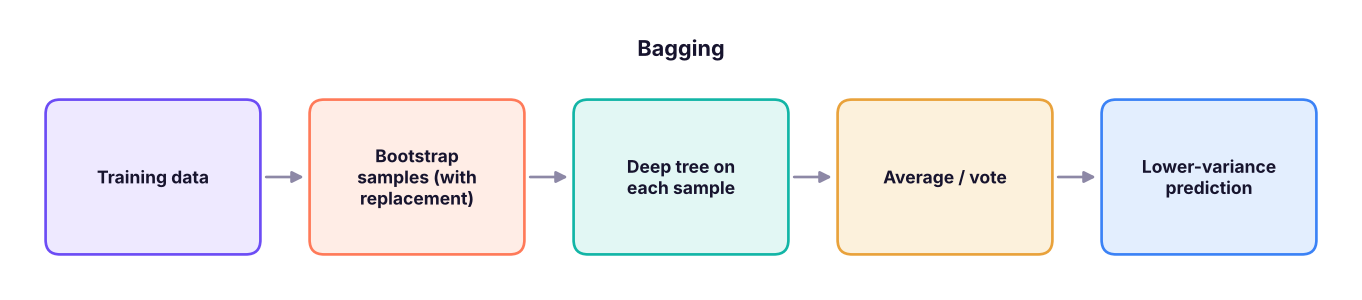
Train each tree on a bootstrap sample (rows drawn with replacement, same size as the data), then average predictions (regression) or vote (classification). Each bootstrap sample leaves out about 37% of rows: the out-of-bag (OOB) rows act as a free validation set.
Random forests
A random forest = bagging + a random subset of features considered at each split (max_features). This decorrelates the trees further: a dominant feature cannot sit at the top of every tree.
from sklearn.model_selection import train_test_split, cross_val_score, StratifiedKFold
from sklearn.tree import DecisionTreeClassifier
from sklearn.ensemble import BaggingClassifier, RandomForestClassifier, ExtraTreesClassifier
from sklearn.linear_model import LogisticRegression
from sklearn.metrics import roc_auc_score
tc = pd.read_csv("telecom_churn.csv")
X = pd.get_dummies(tc.drop(columns=["customer_id", "churn", "total_charges"]), drop_first=True).astype(float); y = (tc.churn == "Yes").astype(int)
Xtr, Xte, ytr, yte = train_test_split(X, y, test_size=0.3, stratify=y, random_state=1)
models = {"single deep tree": DecisionTreeClassifier(random_state=0),
          "bagged trees (300)": BaggingClassifier(DecisionTreeClassifier(), n_estimators=300, random_state=0, n_jobs=-1),
          "random forest (300)": RandomForestClassifier(300, random_state=0, n_jobs=-1),
          "random forest, leaf ≥ 20": RandomForestClassifier(300, min_samples_leaf=20, random_state=0, n_jobs=-1),
          "extra trees, leaf ≥ 20": ExtraTreesClassifier(300, min_samples_leaf=20, random_state=0, n_jobs=-1)}
for name, m in models.items():
    m.fit(Xtr, ytr)
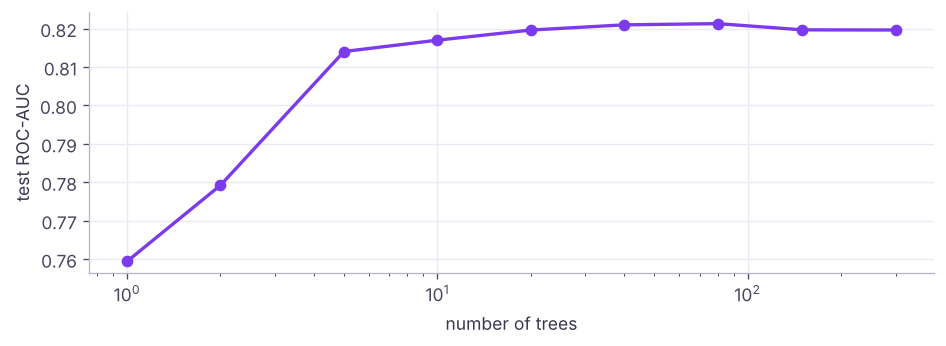
print(f"{name:26s} train AUC {roc_auc_score(ytr, m.predict_proba(Xtr)[:, 1]):.3f} | test AUC {roc_auc_score(yte, m.predict_proba(Xte)[:, 1]):.3f}")single deep tree train AUC 1.000 | test AUC 0.630 bagged trees (300) train AUC 1.000 | test AUC 0.763 random forest (300) train AUC 1.000 | test AUC 0.771 random forest, leaf ≥ 20 train AUC 0.847 | test AUC 0.820 extra trees, leaf ≥ 20 train AUC 0.836 | test AUC 0.815
Out-of-bag evaluation
rf = RandomForestClassifier(500, min_samples_leaf=20, oob_score=True, random_state=0, n_jobs=-1).fit(Xtr, ytr)
from sklearn.metrics import roc_auc_score as auc
print(f"OOB accuracy {rf.oob_score_:.3f} | OOB AUC {auc(ytr, rf.oob_decision_function_[:, 1]):.3f} | test AUC {auc(yte, rf.predict_proba(Xte)[:, 1]):.3f}")OOB accuracy 0.786 | OOB AUC 0.793 | test AUC 0.819
OOB scores approximate test performance without a separate validation set, which is handy for quick tuning.
Key hyperparameters
| Parameter | Typical values | Effect |
|---|---|---|
n_estimators |
200–1,000 | More trees = more stable; plateau |
max_features |
"sqrt" (classification), 0.3–1.0 (regression) |
Lower = more diverse, less correlated trees |
max_depth / min_samples_leaf |
None / 1–50 | Leaf size smooths probabilities; key for noisy data |
max_samples |
0.5–1.0 | Bootstrap sample size (faster, more diverse) |
class_weight |
"balanced", "balanced_subsample" |
Imbalanced classes |
n_jobs=-1 |
Use all CPU cores |
from sklearn.model_selection import RandomizedSearchCV
from scipy.stats import randint, uniform
cv = StratifiedKFold(5, shuffle=True, random_state=0)
search = RandomizedSearchCV(RandomForestClassifier(300, random_state=0, n_jobs=-1),
                            {"max_features": uniform(0.1, 0.8), "min_samples_leaf": randint(1, 60), "max_depth": [None, 4, 8, 12]},
                            n_iter=20, cv=cv, scoring="roc_auc", random_state=0).fit(Xtr, ytr)
print({k: (round(float(v), 3) if isinstance(v, float) else v) for k, v in search.best_params_.items()}, f"| CV AUC {search.best_score_:.3f} | test AUC {auc(yte, search.predict_proba(Xte)[:, 1]):.3f}")
lr = LogisticRegression(max_iter=2000).fit(Xtr, ytr); print(f"logistic regression test AUC {auc(yte, lr.predict_proba(Xte)[:, 1]):.3f}"){'max_depth': 4, 'max_features': 0.37, 'min_samples_leaf': 21} | CV AUC 0.794 | test AUC 0.819
logistic regression test AUC 0.822On this dataset the relationships are close to additive, so a tuned forest and logistic regression perform similarly. Forests pull ahead when there are strong interactions and thresholds.
Feature importance
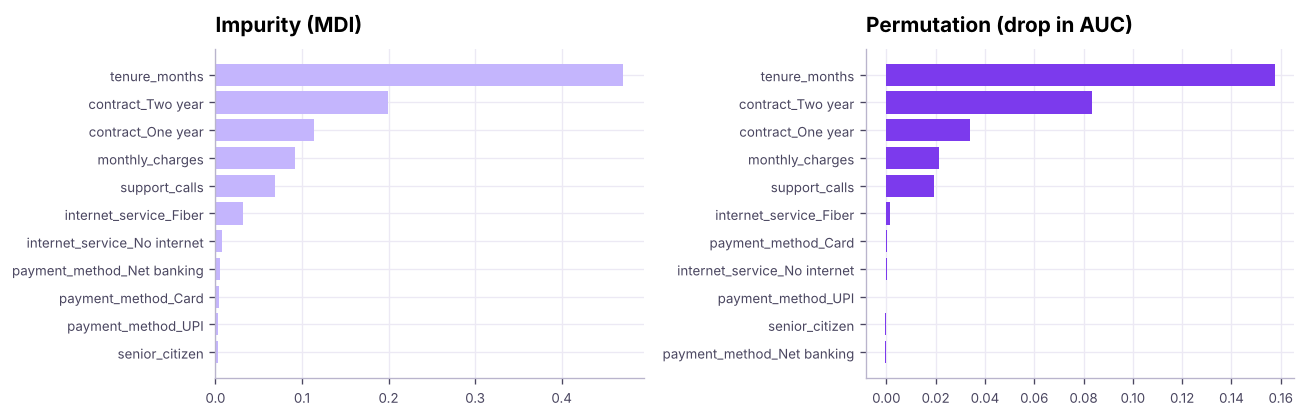
print(pd.DataFrame({"impurity": imp, "permutation": pi}).sort_values("permutation", ascending=False).round(4).head(6))impurity permutation tenure_months 0.4711 0.1575 contract_Two year 0.1996 0.0834 contract_One year 0.1140 0.0339 monthly_charges 0.0925 0.0213 support_calls 0.0683 0.0195 internet_service_Fiber 0.0316 0.0016
Both rank tenure and contract first, but impurity importance (computed on training data) gives continuous features with many possible split points, such as monthly charges, a bigger share; permutation importance on held-out data reflects real predictive value. Neither shows the direction of an effect; use partial dependence or SHAP for that (lesson 27).
Random forest regression
from sklearn.ensemble import RandomForestRegressor
from sklearn.metrics import mean_absolute_error
h = pd.read_csv("house_prices.csv").dropna(subset=["area_sqft"]); h = h[h.price_lakh.between(5, 300)]
Xh = pd.get_dummies(h.drop(columns=["house_id", "price_lakh"]), drop_first=True).astype(float)
a, bq, c, d = train_test_split(Xh, h.price_lakh, test_size=0.2, random_state=0)
rfr = RandomForestRegressor(500, min_samples_leaf=2, max_features=0.6, random_state=0, n_jobs=-1).fit(a, c)
print(f"random forest test MAE {mean_absolute_error(d, rfr.predict(bq)):.2f} lakh | R² {rfr.score(bq, d):.3f}")random forest test MAE 7.39 lakh | R² 0.912
Voting and stacking
Different model families make different errors, so combining them can help.
from sklearn.ensemble import VotingClassifier, StackingClassifier, HistGradientBoostingClassifier
from sklearn.pipeline import make_pipeline
from sklearn.preprocessing import StandardScaler
from sklearn.neighbors import KNeighborsClassifier
base = [("lr", make_pipeline(StandardScaler(), LogisticRegression(max_iter=2000))), ("rf", RandomForestClassifier(300, min_samples_leaf=20, random_state=0, n_jobs=-1)),
        ("knn", make_pipeline(StandardScaler(), KNeighborsClassifier(75)))]
vote = VotingClassifier(base, voting="soft").fit(Xtr, ytr)
stack = StackingClassifier(base, final_estimator=LogisticRegression(), cv=5).fit(Xtr, ytr)
for name, m in [("soft voting", vote), ("stacking", stack)]: print(f"{name:12s} test AUC {auc(yte, m.predict_proba(Xte)[:, 1]):.3f}")soft voting test AUC 0.823 stacking test AUC 0.824
Soft voting averages predicted probabilities; stacking trains a meta-model on the base models' out-of-fold predictions. Gains are usually small and add complexity; Kaggle winners love them, production teams use them sparingly.
Summary
- Ensembles average diverse models so errors cancel; bagging trains each model on a bootstrap sample.
- Random forests add random feature subsets at each split to decorrelate trees; more trees never overfit.
- Tune
max_features,min_samples_leafand depth; use OOB scores for quick validation. - Prefer permutation importance on held-out data to impurity importance; neither gives direction.
- Voting and stacking combine different model families for small extra gains.
1. What is a bootstrap sample?
2. What extra randomness does a random forest add to bagging?
3. What happens if you keep adding trees to a random forest?
4. What are out-of-bag rows used for?
5. Why prefer permutation importance?
6. What does stacking do?
(1) Fit a random forest on the bank loans data and compare its 5-fold AUC with logistic regression. (2) Plot OOB error vs max_features. (3) Train a RandomForestRegressor on house prices and plot predicted vs actual.
Show solution
b = pd.read_csv("bank_loans.csv").dropna(subset=["default"]); fb = ["age", "ed", "employ", "address", "income", "debtinc", "creddebt", "othdebt"]
for m in (RandomForestClassifier(500, min_samples_leaf=10, random_state=0), make_pipeline(StandardScaler(), LogisticRegression(max_iter=1000))):
    print(type(m).__name__, cross_val_score(m, b[fb], b.default.astype(int), cv=cv, scoring="roc_auc").mean())
for mf in (0.1, 0.3, 0.5, 0.8, 1.0): print(mf, 1 - RandomForestClassifier(300, max_features=mf, oob_score=True, random_state=0).fit(Xtr, ytr).oob_score_)
plt.scatter(d, rfr.predict(bq), s=5); plt.plot([0, 300], [0, 300])Q: How does a random forest reduce overfitting compared with a single tree? Each tree sees a different bootstrap sample and random feature subsets, so trees make different errors; averaging them reduces variance while keeping low bias.
Q: Bagging vs boosting? Bagging trains models independently in parallel on bootstrap samples and averages them (reduces variance); boosting trains models sequentially, each correcting the previous errors (reduces bias).
Q: How do you get feature importance from a random forest, and what is the caveat? Impurity-based importance from training splits (biased toward high-cardinality features) or permutation importance on held-out data (more reliable); neither shows the direction of the effect.
Practise more online
Free, trusted places to test yourself on this topic. Links open the original site in a new tab.