
NLP and Text Analytics: Cleaning, TF-IDF, Sentiment Classification, Topics and Embeddings
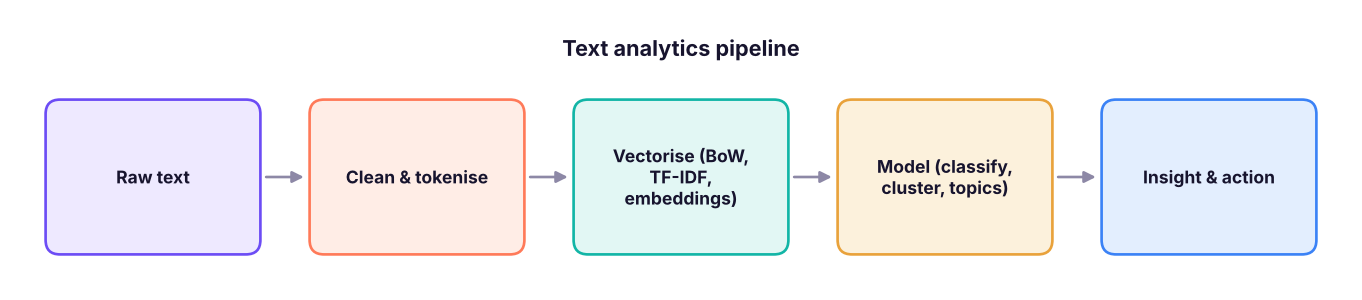
Turn customer reviews into insight. Text cleaning and tokenisation, stop words, stemming and lemmatisation, bag-of-words and TF-IDF with n-grams, a sentiment classifier with error analysis, aspect-level insight, topic modelling with NMF, document similarity, and how embeddings and LLMs change NLP, on 3,000 e-commerce reviews.
- Clean and tokenise text and decide when to remove stop words, stem or lemmatise
- Represent documents with bag-of-words and TF-IDF (with n-grams) and read the vocabulary
- Train, evaluate and interpret a sentiment classifier, including error analysis
- Extract topics with NMF and aspect-level sentiment with simple rules
- Explain word and sentence embeddings and when to use LLMs instead
The NLP pipeline
import pandas as pd, numpy as np, re
pd.set_option("display.width", 160); pd.set_option("display.max_colwidth", 90)
rv = pd.read_csv("customer_reviews.csv", parse_dates=["date"])
print(rv.shape, rv.sentiment.value_counts(normalize=True).round(3).to_dict())
print(rv.groupby("product").rating.mean().round(2).sort_values().to_dict())
print(rv.sample(5, random_state=3)[["rating", "review_text"]].to_string(index=False))
rv["n_words"] = rv.review_text.str.split().str.len()
print("words per review:", rv.n_words.describe().round(1)[["mean", "50%", "max"]].to_dict(), "| by sentiment:", rv.groupby("sentiment").n_words.mean().round(1).to_dict())(3000, 8) {'positive': 0.53, 'negative': 0.321, 'neutral': 0.149}
{'Tablet': 3.27, 'Smartwatch': 3.29, 'Speaker': 3.3, 'Earbuds': 3.31, 'Smartphone': 3.33, 'Laptop': 3.36}
rating review_text
4 Superb product. Customer support solved my issue quickly, the app is totally smooth, charges really totally fast :)
5 Price is very very reasonable for these features though the buttons are loose, no issues so far
2 Worst purchase ever. Sound is tinny, not wroth it
5 Highly recommend. Calls are crystal clear!
5 Highly recommend. Build quality feels premium, price is very reasonable for these features, no issues so far.
words per review: {'mean': 12.9, '50%': 13.0, 'max': 34.0} | by sentiment: {'negative': 13.9, 'neutral': 9.2, 'positive': 13.3}Cleaning and tokenising
STOP = {"the", "a", "an", "is", "it", "and", "to", "of", "for", "in", "on", "was", "this", "that", "with", "my", "i", "very", "so", "are", "be", "at", "as", "after", "all"}
NEGATIONS = {"not", "no", "never", "don't", "can't", "isn't", "wasn't"}
FIX = {"batery": "battery", "qualty": "quality", "delivry": "delivery", "realy": "really", "scren": "screen", "wroth": "worth", "bekaar": "useless", "badiya": "good"}
def clean(text, remove_stop=True):
    t = text.lower()
    t = re.sub(r"[:;]-?[()]", " ", t)                       # emoticons
    t = re.sub(r"[^a-z' ]+", " ", t)                        # keep letters and apostrophes
    tokens = [FIX.get(w, w) for w in t.split()]
    if remove_stop: tokens = [w for w in tokens if w not in STOP or w in NEGATIONS]
    return " ".join(tokens)
ex = rv.review_text.iloc[7]
print("raw:  ", ex); print("clean:", clean(ex))
rv["clean"] = rv.review_text.map(clean)raw: Battery backup is totally superb but sound is tinny. Average product for daily use clean: battery backup totally superb but sound tinny average product daily use
| Step | Purpose | Caution |
|---|---|---|
| Lower-casing | "Battery" = "battery" | Loses emphasis ("GREAT") |
| Remove punctuation, numbers, URLs | Reduce noise | Prices and model numbers may matter |
| Spelling / slang normalisation | Merge variants ("batery", Hinglish "badiya") | Needs a dictionary |
| Stop-word removal | Drop frequent function words | Never drop negations ("not") for sentiment |
| Stemming (Porter, Snowball) | "charging", "charged" → "charg" | Crude, can merge different words |
| Lemmatisation (spaCy) | "better" → "good", "batteries" → "battery" | Slower, needs a language model |
Libraries: spaCy (fast tokenisation, lemmas, entities), NLTK (classic teaching toolkit), regex; for Indian languages, IndicNLP and multilingual models.
Bag-of-words and TF-IDF
Bag-of-words counts each word per document, ignoring order. TF-IDF down-weights words that appear in many documents (like "product") and up-weights distinctive ones:

from sklearn.feature_extraction.text import CountVectorizer, TfidfVectorizer
docs = ["battery drains fast", "battery lasts all day", "screen is not great", "great screen and great battery"]
cv = CountVectorizer(); bow = cv.fit_transform(docs)
print(pd.DataFrame(bow.toarray(), columns=cv.get_feature_names_out(), index=[f"doc{i}" for i in range(4)]))
tf = TfidfVectorizer(); tfm = tf.fit_transform(docs)
print(pd.DataFrame(tfm.toarray().round(2), columns=tf.get_feature_names_out(), index=[f"doc{i}" for i in range(4)]).loc[:, ["battery", "great", "not", "drains"]])
bi = CountVectorizer(ngram_range=(1, 2)).fit(["screen is not great"]); print("with bigrams:", bi.get_feature_names_out().tolist()) all and battery day drains fast great is lasts not screen
doc0 0 0 1 0 1 1 0 0 0 0 0
doc1 1 0 1 1 0 0 0 0 1 0 0
doc2 0 0 0 0 0 0 1 1 0 1 1
doc3 0 1 1 0 0 0 2 0 0 0 1
battery great not drains
doc0 0.41 0.00 0.00 0.64
doc1 0.35 0.00 0.00 0.00
doc2 0.00 0.44 0.56 0.00
doc3 0.30 0.74 0.00 0.00
with bigrams: ['great', 'is', 'is not', 'not', 'not great', 'screen', 'screen is']Bigrams such as "not great" keep some word order, which matters for sentiment.
Sentiment classifier
from sklearn.model_selection import train_test_split
from sklearn.pipeline import make_pipeline
from sklearn.linear_model import LogisticRegression
from sklearn.metrics import classification_report, confusion_matrix, accuracy_score
Xtr, Xte, ytr, yte = train_test_split(rv.clean, rv.sentiment, test_size=0.25, stratify=rv.sentiment, random_state=0)
for name, vec in [("unigrams", TfidfVectorizer(min_df=2)), ("uni + bigrams", TfidfVectorizer(ngram_range=(1, 2), min_df=2, sublinear_tf=True))]:
    m = make_pipeline(vec, LogisticRegression(max_iter=3000, C=5)).fit(Xtr, ytr)
    print(f"{name:14s} accuracy {accuracy_score(yte, m.predict(Xte)):.3f} | vocabulary {len(m[0].vocabulary_):,}")
clf = m
print(classification_report(yte, clf.predict(Xte), digits=3))
labels = ["negative", "neutral", "positive"]
print(pd.DataFrame(confusion_matrix(yte, clf.predict(Xte), labels=labels), index=[f"true {l}" for l in labels], columns=[f"pred {l}" for l in labels]))unigrams accuracy 0.935 | vocabulary 183
uni + bigrams accuracy 0.940 | vocabulary 1,546
precision recall f1-score support
negative 0.974 0.938 0.956 241
neutral 0.860 0.821 0.840 112
positive 0.942 0.975 0.958 397
accuracy 0.940 750
macro avg 0.925 0.911 0.918 750
weighted avg 0.940 0.940 0.940 750
pred negative pred neutral pred positive
true negative 226 6 9
true neutral 5 92 15
true positive 1 9 387What did it learn?
vocab = np.array(clf[0].get_feature_names_out())
for i, c in enumerate(clf[-1].classes_):
top = np.argsort(-clf[-1].coef_[i])[:8]; print(f"{c:9s} ←", vocab[top].tolist())negative ← ['disappointed', 'useless', 'useless product', 'buying', 'regret', 'regret buying', 'purchase ever', 'ever'] neutral ← ['but', 'fine', 'expected', 'loved build', 'but too', 'early but', 'okay', 'okay price'] positive ← ['loved', 'though', 'superb', 'happy purchase', 'superb product', 'not disappointed', 'bahut good', 'bahut']
Error analysis
pred = clf.predict(Xte); proba = clf.predict_proba(Xte).max(1)
err = pd.DataFrame({"text": rv.loc[Xte.index, "review_text"], "rating": rv.loc[Xte.index, "rating"], "true": yte, "pred": pred, "confidence": proba.round(2)})[pred != yte]
print(len(err), "errors"); print(err.sort_values("confidence", ascending=False).head(6).to_string(index=False))45 errors
text rating true pred confidence
Happy with the purchase. Calls are crystal super clear, arrived a day early, price is very reasonable for these features 3 neutral positive 1.00
Bahut badiya. Bass is rich, replacement was smooth 2 negative positive 1.00
Worst purchase ever. Too much bloatware, battery drains too fast! 3 neutral negative 0.99
Loved it! setup took two minutes, great value for money, sound is really clear and loud 3 neutral positive 0.99
Bahut badiya. The app is super smooth, replacement was smooth 3 neutral positive 0.99
Superb product. Bass is rich!! 2 negative positive 0.99Reading errors is the most useful step in NLP. Typical causes here: noisy labels (a 1-star rating on a positive text), mixed reviews ("good screen but weak battery") and genuinely neutral wording. Fixes include better labels, aspect-level models, or an LLM for difficult cases.
Aspect-level insight
Overall sentiment hides what customers like or dislike. A simple keyword approach already gives actionable results:
ASPECTS = {"battery": r"batter|charg", "screen": r"screen|display|pixel|touch", "sound": r"sound|bass|speaker|mic", "build": r"build|hinge|button|finish|plastic",
           "delivery": r"deliver|courier|box|packag|arriv", "service": r"support|service|refund|replacement|care", "price": r"price|money|rupee|expensive|worth", "software": r"app|update|bloatware|setup"}
low = rv.review_text.str.lower()
rows = []
for a, pat in ASPECTS.items():
    m = low.str.contains(pat, regex=True)
    rows.append({"aspect": a, "mentions": int(m.sum()), "share_negative_%": round(100 * (rv.sentiment[m] == "negative").mean(), 1), "avg_rating": round(rv.rating[m].mean(), 2)})
asp = pd.DataFrame(rows).sort_values("share_negative_%", ascending=False); print(asp.to_string(index=False))
print(rv.assign(battery=low.str.contains(ASPECTS["battery"])).query("battery").groupby("product").rating.mean().round(2).sort_values().head(3).to_dict()) aspect mentions share_negative_% avg_rating
sound 659 42.8 3.08
build 572 37.1 3.23
price 867 36.9 3.24
screen 741 35.9 3.30
service 792 35.6 3.31
software 1165 34.6 3.34
battery 752 32.4 3.38
delivery 945 30.6 3.41
{'Smartwatch': 3.2, 'Speaker': 3.35, 'Earbuds': 3.37}Production systems use aspect-based sentiment analysis models or LLM prompts ("list each product aspect mentioned and its sentiment as JSON").
Topic modelling
Topic models discover groups of words that co-occur, without labels. NMF on TF-IDF is fast and gives readable topics (LDA on counts is the classic alternative; BERTopic uses embeddings).
from sklearn.decomposition import NMF
tfidf = TfidfVectorizer(max_df=0.5, min_df=5, ngram_range=(1, 2), stop_words="english")
Xt = tfidf.fit_transform(rv.review_text.str.lower())
nmf = NMF(n_components=6, random_state=0, init="nndsvda", max_iter=500).fit(Xt)
terms = np.array(tfidf.get_feature_names_out())
for k, comp in enumerate(nmf.components_): print(f"topic {k}:", ", ".join(terms[np.argsort(-comp)[:7]]))
rv["topic"] = nmf.transform(Xt).argmax(1)
print(rv.groupby("topic").agg(reviews=("rating", "size"), avg_rating=("rating", "mean")).round(2).T)topic 0: battery, day, superb, screen, lasts, clear, smooth topic 1: support, support solved, solved issue, issue quickly, solved, issue, customer support topic 2: centre, service centre, service, centre staff, staff, helpful, waiting days topic 3: weeks, high volume, speaker, high, crackles high, crackles, volume topic 4: quality, feels, build, premium, build quality, quality feels, feels premium topic 5: value, value money, money, great value, great, packaging, safe topic 0 1 2 3 4 5 reviews 1015.00 197.00 230.00 915.00 393.00 250.00 avg_rating 4.29 3.91 3.17 1.97 3.14 4.18
Name each topic from its top words (for example "battery and charging", "delivery and packaging") and track topic volume and rating over time.
Similarity search
from sklearn.metrics.pairwise import cosine_similarity
from sklearn.decomposition import TruncatedSVD
lsa = make_pipeline(TfidfVectorizer(ngram_range=(1, 2), min_df=2, stop_words="english"), TruncatedSVD(100, random_state=0)).fit(rv.review_text)
E = lsa.transform(rv.review_text)
for query in ["the battery runs out quickly and charging takes forever", "phone heats up and power does not last"]:
    sims = cosine_similarity(lsa.transform([query]), E)[0]; best = np.argsort(-sims)[:3]
print("query:", query); [print(f" {sims[i]:.2f} {rv.review_text.iloc[i]}") for i in best]query: the battery runs out quickly and charging takes forever 0.76 Customer support solved my issue quickly but charging is painfully really slow. 0.74 Very disappointed. Charging is painfully slow, screen is totally dull but customer support solved my issue quickly 0.69 Charging is painfully slow query: phone heats up and power does not last 1.00 Nothing special, does the job 1.00 Nothing special, does the job. 1.00 Nothing special, does the job.
Latent semantic analysis (TF-IDF + SVD) finds the charging complaints for the first query. The second query fails badly: "heats" and "power" never appear in the reviews and "last" is a different token from "lasts", so LSA matches the only shared word, "does". Word-count methods cannot know that "power does not last" means the battery drains. Modern embeddings do this far better.
Embeddings and LLMs
| Approach | Idea | Use |
|---|---|---|
| Word2Vec, GloVe, fastText (2013–2016) | Each word gets a dense vector; similar words are close | Features, similarity |
| Transformers (BERT, 2018 →) | Contextual vectors: "bank" differs in "river bank" and "bank loan" | Fine-tuned classifiers, NER |
| Sentence embeddings (sentence-transformers, OpenAI/Cohere/Voyage/Gemini embedding APIs) | One vector per sentence or document | Semantic search, clustering, RAG |
| LLMs (Claude, GPT, Gemini, Llama) | Instruction-following generation | Zero-shot classification, extraction, summarisation |
# Sentence embeddings (pip install sentence-transformers) – runs locally
from sentence_transformers import SentenceTransformer
model = SentenceTransformer("all-MiniLM-L6-v2")
emb = model.encode(rv.review_text.tolist(), normalize_embeddings=True)    # 3,000 × 384 matrix
# then: LogisticRegression on emb, KMeans on emb, or cosine search as above# Zero-shot classification with an LLM (see the GenAI track for API set-up and cost control)
prompt = """Classify the review's sentiment as positive, negative or neutral and list aspects mentioned.
Return JSON: {"sentiment": ..., "aspects": [{"aspect": ..., "sentiment": ...}]}
Review: "Good screen but the battery barely lasts half a day." """When to use what: TF-IDF + logistic regression is cheap, fast, explainable and often within a few points of large models on simple tasks. Embeddings help with semantic similarity and small labelled sets. LLMs handle nuanced, multi-aspect or multilingual text with few or no labels, at higher cost and latency; validate them on a labelled sample just like any model.
Summary
- Clean text deliberately: lower-case, normalise spelling and slang, keep negations; stem or lemmatise when useful.
- Bag-of-words counts words; TF-IDF weights distinctive words; bigrams capture short phrases like "not great".
- A TF-IDF + logistic regression classifier is a strong, explainable baseline; error analysis reveals noisy labels and mixed reviews.
- Aspect keywords and NMF topics turn reviews into product actions.
- Embeddings and LLMs capture meaning beyond exact words; benchmark them against the classical baseline.
1. Why should "not" be kept when removing stop words for sentiment?
2. What does IDF do in TF-IDF?
3. What do bigrams add?
4. Which method finds topics without labels?
5. What is a sentence embedding?
6. When might TF-IDF + logistic regression be the better choice than an LLM?
(1) Add a feature for exclamation marks and review length and test whether accuracy changes. (2) Track the monthly share of negative battery reviews. (3) Try ComplementNB and LinearSVC and compare macro F1. (4) Write an LLM prompt for aspect-based sentiment and test it on 10 reviews (GenAI track).
Show solution
from scipy.sparse import hstack
from sklearn.svm import LinearSVC
from sklearn.naive_bayes import ComplementNB
from sklearn.metrics import f1_score
monthly = rv.assign(m=rv.date.dt.to_period("M"), batt=low.str.contains(ASPECTS["battery"])).query("batt").groupby("m").sentiment.apply(lambda s: (s == "negative").mean()); print(monthly.round(2))
for est in (ComplementNB(), LinearSVC(C=0.5)):
mm = make_pipeline(TfidfVectorizer(ngram_range=(1, 2), min_df=2), est).fit(Xtr, ytr); print(type(est).__name__, f1_score(yte, mm.predict(Xte), average="macro"))Q: How would you build a sentiment model for customer reviews? Define labels (stars or manual), clean text keeping negations, start with TF-IDF + logistic regression, evaluate with macro F1 and a confusion matrix, analyse errors, then try embeddings or a fine-tuned transformer/LLM if needed, and monitor drift.
Q: TF-IDF vs embeddings? TF-IDF is sparse, exact-word based and interpretable; embeddings are dense and capture meaning, synonyms and context, at the cost of interpretability and compute.
Q: How do you find what customers complain about most? Aspect extraction (keywords, NER, or LLM prompts) combined with sentiment per aspect, plus topic modelling to discover unexpected themes, tracked over time.
Practise more online
Free, trusted places to test yourself on this topic. Links open the original site in a new tab.